
COURSE DESCRIPTION
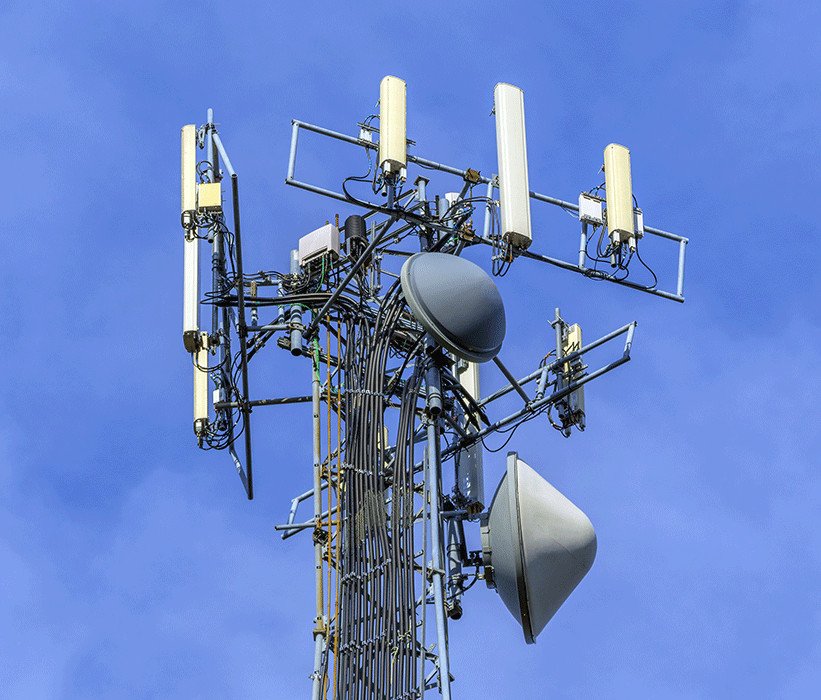
Topics covered include: digital communications at the block diagram level, data compression, Lempel-Ziv algorithm, scalar and vector quantization, sampling and aliasing, the Nyquist criterion, PAM and QAM modulation, signal constellations, finite-energy waveform spaces, detection, and modeling and system design for wireless communication.

Syllabus
Course Meeting Times
Lectures: 2 sessions / week, 1.5 hours / session
Description
This course is a graduate level introduction to the basic principles of digital communication systems. A digital communication system is one that transmits a source (voice, video, data, etc.) from one point to another, by first converting it into a stream of bits, and then into symbols that can be transmitted over channels (cable, wireless, storage, etc.). The use of the digital bit-stream as the interface between the source and the channel is universal regardless of what kind of source and channel are involved. Digital communication principle, with “bit” as the most important concept of the information age, and applications in computer science, Internet, wireless, etc., is one of the most successful stories of applying mathematics in engineering designs.
The course gives an overview of the designs of digital communication systems. We explain the mathematical foundation of decomposing the systems into separately designed source codes and channel codes. We introduce the principles and some commonly used algorithms in each component, to convert continuous time waveforms into bits, and vice versa. We give a comprehensive introduction to the basics of information theory, a rather thorough treatment of Fourier transforms and the sampling theorem, and an overview of the use of vector spaces in signal processing.
The course would be beneficial particularly to students who are interested in doing research in fields related to communications, networks, and signal processing. The general principle and philosophy of the engineering designs discussed in this course are inspiring to all engineering majors. As a Technical Qualifying Exam (TQE) course, we also try to offer some rigorous mathematical training. The materials of this course are the baselines of further studies in 6.451 (digital communications II), 6.452 (wireless communications), and 6.441 (information theory).
Lecture 1: Introduction
Topics covered: Introduction: A layered view of digital communication
Instructors: Prof. Robert Gallager, Prof. Lizhong Zheng
Lecture 2: Discrete Source Encoding
Topics covered: Discrete source encoding
Instructors: Prof. Robert Gallager, Prof. Lizhong Zheng
Lecture 3: Memory-less Sources
Topics covered: Memory-less sources, prefix free codes, and entropy
Instructors: Prof. Robert Gallager, Prof. Lizhong Zheng
Lecture 4: Entropy and Asymptotic Equipartition Property
Topics covered: Entropy and asymptotic equipartition property
Instructors: Prof. Robert Gallager, Prof. Lizhong Zheng
Lecture 5: Markov Sources
Topics covered: Markov sources and Lempel-Ziv universal codes
Instructors: Prof. Robert Gallager, Prof. Lizhong Zheng
Lecture 6: Quantization
Topics covered: Quantization
Instructors: Prof. Robert Gallager, Prof. Lizhong Zheng
Lecture 7: High Rate Quantizers and Waveform Encoding
Topics covered: High rate quantizers and waveform encoding
Instructors: Prof. Robert Gallager, Prof. Lizhong Zheng
Lecture 8: Measure
Topics covered: Measure, fourier series, and fourier transforms
Instructors: Prof. Robert Gallager, Prof. Lizhong Zheng
Lecture 9: Discrete-Time Fourier Transforms
Topics covered: Discrete-time fourier transforms and sampling theorem
Instructors: Prof. Robert Gallager, Prof. Lizhong Zheng
Lecture 10: Degrees of Freedom
Topics covered: Degrees of freedom, orthonormal expansions, and aliasing
Instructors: Prof. Robert Gallager, Prof. Lizhong Zheng
Lecture 11: Signal Space
Topics covered: Signal space, projection theorem, and modulation
Instructors: Prof. Robert Gallager, Prof. Lizhong Zheng
Lecture 12: Nyquist Theory
Lecture 13: Random Processes
Topics covered: Random processes
Instructors: Prof. Robert Gallager, Prof. Lizhong Zheng
Lecture 14: Jointly Gaussian Random Vectors
Topics covered: Jointly Gaussian random vectors and processes and white Gaussian noise (WGN)
Instructors: Prof. Robert Gallager, Prof. Lizhong Zheng
Lecture 15: Linear Functionals
Topics covered: Linear functionals and filtering of random processes
Instructors: Prof. Robert Gallager, Prof. Lizhong Zheng
Lecture 16: Review; Introduction to Detection
Topics covered: Review; introduction to detection
Instructors: Prof. Robert Gallager, Prof. Lizhong Zheng
Lecture 17: Detection for Random Vectors and Processes
Topics covered: Detection for random vectors and processes
Instructors: Prof. Robert Gallager, Prof. Lizhong Zheng
Lecture 18: Theory of Irrelevance
Topics covered: Theorem of irrelevance, M-ary detection, and coding
Instructors: Prof. Robert Gallager, Prof. Lizhong Zheng
Lecture 19: Baseband Detection
Topics covered: Baseband detection and complex Gaussian processes
Instructors: Prof. Robert Gallager, Prof. Lizhong Zheng
Lecture 20: Introduction of Wireless Communication
Topics covered: Introduction of wireless communication
Instructors: Prof. Robert Gallager, Prof. Lizhong Zheng
Lecture 21: Doppler Spread
Topics covered: Doppler spread, time spread, coherence time, and coherence frequency
Instructors: Prof. Robert Gallager, Prof. Lizhong Zheng
Lecture 22: Discrete-Time Baseband Models for Wireless Channels
Topics covered: Discrete-time baseband models for wireless channels
Instructors: Prof. Robert Gallager, Prof. Lizhong Zheng
Lecture 23: Detection for Flat Rayleigh Fading and Incoherent Channels
Topics covered: Detection for flat rayleigh fading and incoherent channels, and rake receivers
Instructors: Prof. Robert Gallager, Prof. Lizhong Zheng
Lecture 24: Case Study on Code Division Multiple Access
Topics covered: Case study — code division multiple access (CDMA)
Instructors: Prof. Robert Gallager, Prof. Lizhong Zheng